00:00
:00
utc
If both departure and destination airport codes are selected and the route is in the OM-C table (See 'B' below), inferred ETA and Flight Time is automatically prefilled. This can be overwritten with current details.
New feature: all 5 duty selector buttons now have their information overlays placed at blue dots above them.
Usual workflow:
1: Select Destination here. (Departure
usually automatically selected).
2: Enter ETD.
Device keyboard also works.
Most fields are now filled with basic
info, including uncorrected MAX FDP.
3: Customise and update other fields as
needed.
4: App saves history each time COPY
DATA is pressed.
Press REFRESH button for a new
calculation.
This website has been developed with care and in accordance with applicable EASA flight and duty time regulations. However, no guarantee is made regarding the accuracy or completeness of its calculations or information.
The developer is not liable for any incorrect planning outcomes or related operational or financial effects. Users remain solely responsible for verifying compliance with all relevant regulations and company policies.
Usual workflow:
1: Select Destination here. (Departure
usually automatically selected).
2: Enter ETD.
Device keyboard also works.
Most fields are now filled with basic
info, including uncorrected MAX FDP.
3: Customise and update other fields as
needed.
4: App saves history each time COPY
DATA is pressed.
Press REFRESH button for a new
calculation.
This website has been developed with care and in accordance with applicable EASA flight and duty time regulations. However, no guarantee is made regarding the accuracy or completeness of its calculations or information.
The developer is not liable for any incorrect planning outcomes or related operational or financial effects. Users remain solely responsible for verifying compliance with all relevant regulations and company policies.
Website update 2026-02-01
FDP FMS
MAX FDP is derived from the LOCAL time of the UTC value here.
In case of a DELAY AFTER DUTY STARTS, still use this time as your ON DUTY 'FDP reference time'.
Add the DURATION of a DELAY, then enter as ACTUAL REPORTING below.
*Ensure standby callout duties are factored in. See 'S' to the right here for reference.
Pressing 2 or 3 automatically enters a table value for this crew configuration.
Ensure correct DEPT timezone set.
𝌭 The user remains responsible for all FDP calculations.
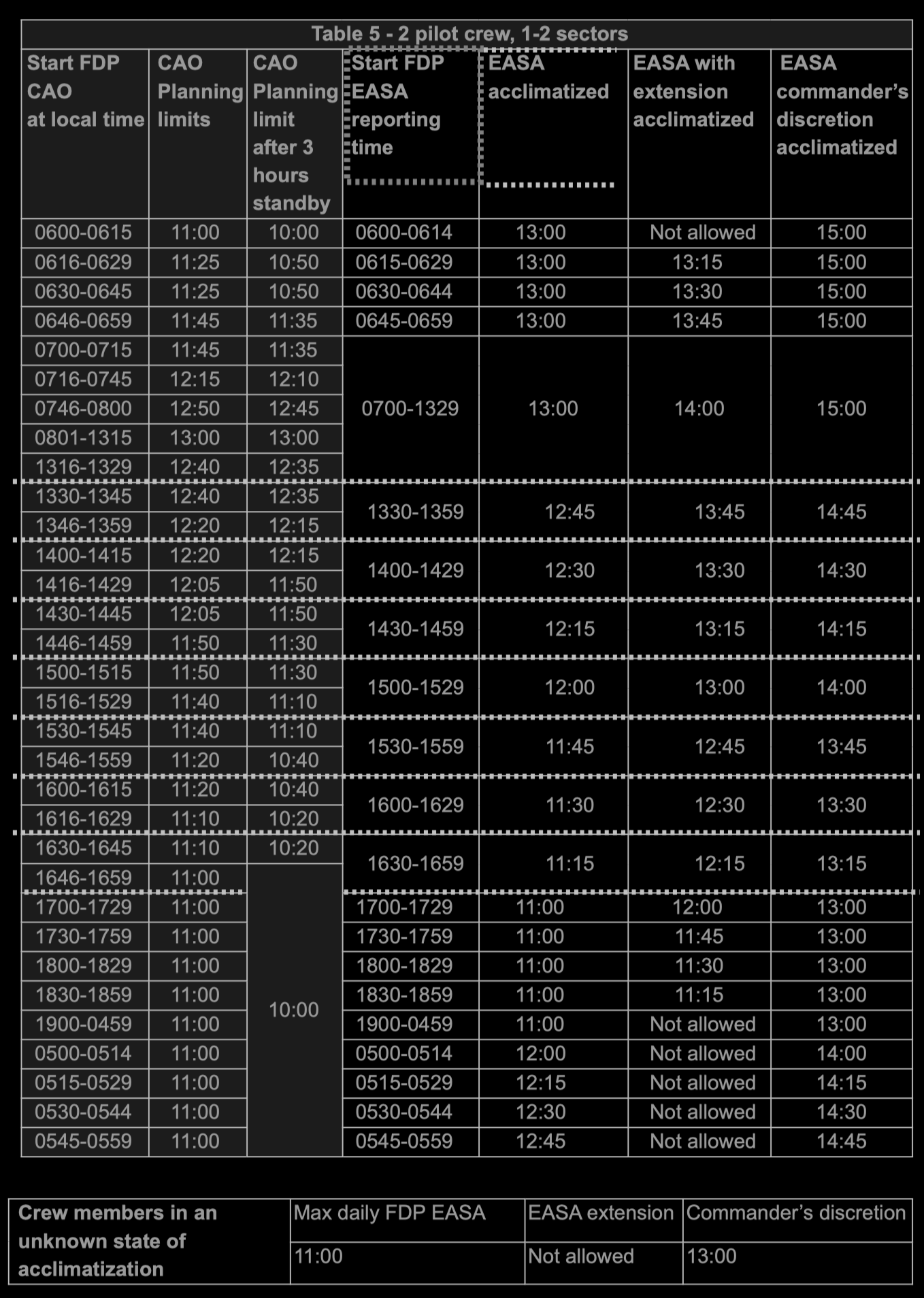
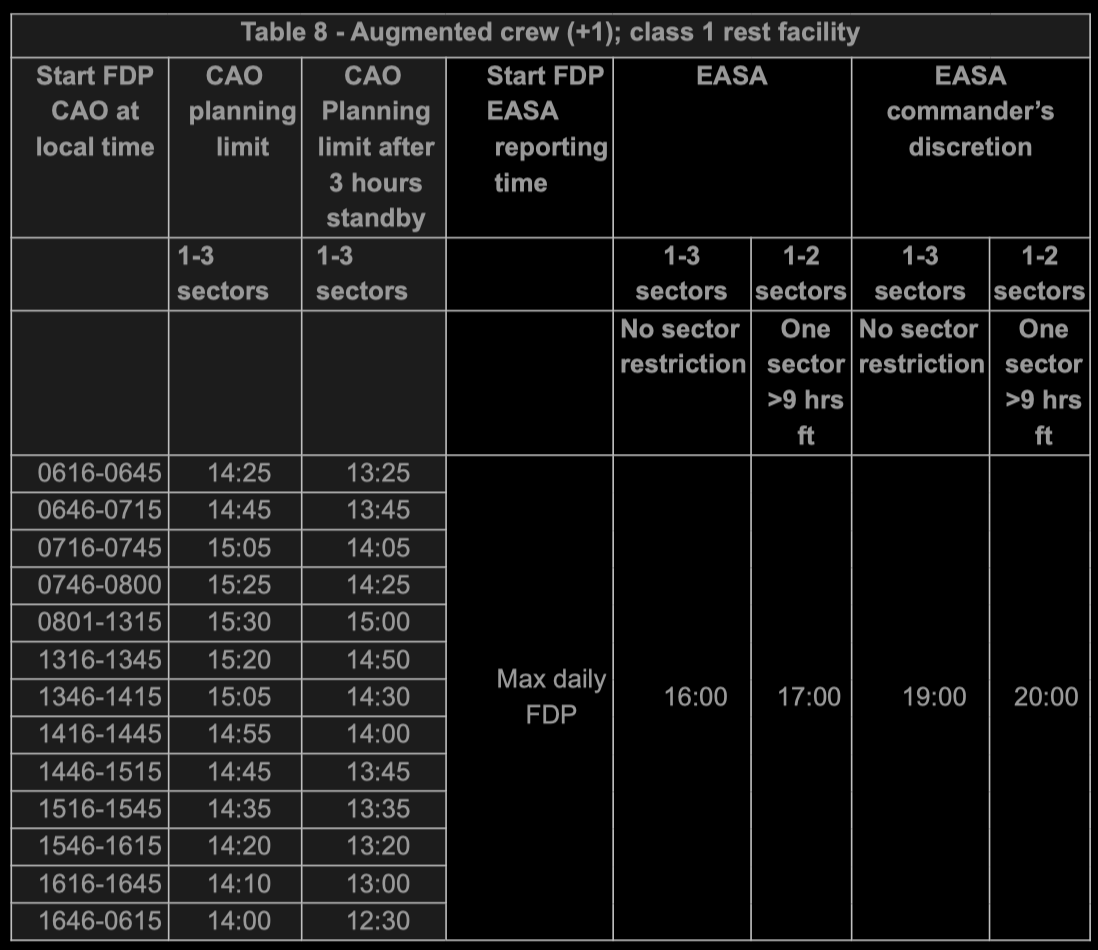
C is CAO ALLOWED PLANNING MAX FDP
S is CAO PLANNING LIMIT AFTER 3 HOURS STANDBY.
For more, see tables at 🅂 button.
FDP FMS is primarily designed to protect EASA limits. CAO limits do not apply AFTER crew is on active flight duty; these are for the planning phase only.
Ensure correct DEPT timezone set.
𝌭 The user remains responsible for all FDP calculations.
C is CAO ALLOWED PLANNING MAX FDP
S is CAO PLANNING LIMIT AFTER 3 HOURS STANDBY.
For more, see tables at 🅂 button.
FDP FMS is primarily designed to protect EASA limits. CAO limits do not apply AFTER crew is on active flight duty; these are for the planning phase only.
manually set to ASSIGNED ON DUTY time +
DELAY BEFORE REPORTING # hrs.
This field is prefilled.
💡 If no changes are needed, pressing ⇥ TAB jumps the cursor to the next field.
This leaves current input unchanged.
Use ⇥ in any field that does not need modification.
OM A 7.1.7(a)(1) 75 mins. standard reporting time
See included documentation at the OM-A 7 button below here, thumbnail 6.
See included documentation at the OM-A 7 button below here, thumbnail 6.
DATAPOINT NEEDED TO DETERMINE IF
THE FLIGHT CAN BE DONE WITHIN
EASA FDP LIMITS.
It is determined by the ASSIGNED
ON DUTY time plus the MAX FDP.
NB: The 30 minute post-flight duty is not used here.
It is used for minimum rest for the next duty.
NB: The CAO text is found behind the OM-A 7 reference here.
CALCULATE USING ROSTER OR AIRCRAFT SCHEDULE
💡 Alternatively start with entering ASSIGNED ON DUTY:
ETD will then be prefilled with ACTUAL REPORTING + PREFLIGHT DURATION.
💡 For 2 sector duties: before the 1st sector enter the ETD of the 1st and the ETA of the 2nd SCHEDULE.
WHEN IN TRANSIT BEFORE THE SECOND SECTOR
DEPARTURE:
Either enter the ETD and ETA of the second segment here,
and/or use the OFP Segment below
to determine if departure can be done
within EASA limits.
Ensure your ASSIGNED ON DUTY remains your 1st DEPT airport with the correct LCL time your crew started work today.
💡Schedule Times can also be found on AVIOCONNECT, handy for quick and early reference but these are not always updated and are not official.
For 2 sector duties, always enter the ETA of the LAST sector.
💡 You can also plan early by adding the OM-C 2.1.5.2 Block times to your UTC ETD.
See the table at the B button here.
If the route is in the table, Block time is automatically added to ETD, showing an 'OM-C' derived ETA.
💡 You can also plan early by adding the OM-C 2.1.5.2 Block times to your UTC ETD.
See the table at the B button here.
If the route is in the table, Block time is automatically added to ETD, showing an 'OM-C' derived ETA.
💡 For two sector duties this will be the sum of:
1st flight + transit + 2nd flight.
Margin: MAX POSSIBLE BLOCKTIME −
PLANNED TOTAL BLOCKTIME
CAO MARGIN= C − PREFLIGHT − PLANNED TOTAL BLOCKTIME
S is not shown here.
Mind CAO limits do not apply if on active flight duty.
On two sector duties Margin is only correct if data entered as ETD 1st and ETA 2nd leg.
MARGIN
💡 Using ETD either from your original departure or 2nd airport.
CALCULATE USING FLIGHT APP BRIEFING OFP OVERVIEW
ETOT − ETD.
Mind STD should not be used instead of ETD here.
Alternatively: estimate your ground delay, such as caused by DE-ICING
Mind STD should not be used instead of ETD here.
Alternatively: estimate your ground delay, such as caused by DE-ICING
FLIGHT TIME shown below OFP RLS #
💡
If the route is in the Block times table, FLIGHT TIME is inferred here, considering TAXI times.
💡
If the route is in the Block times table, FLIGHT TIME is inferred here, considering TAXI times.
ETA − ELDT. Do not use STA here*.
Find these times on your AVIOBOOK FLIGHT APP > BRIEFING > OVERVIEW.
💡 With this 'FMS' segment, either use your first sector OFP, or second OFP while in transit.
IE: this app segment is most suitable to use on single (remaining) sector duties to see if the OFP needs modification.
*STD and STA (also displayed in the header of the FLIGHT APP), are not updated by dispatch in case of delays.
Find these times on your AVIOBOOK FLIGHT APP > BRIEFING > OVERVIEW.
💡 With this 'FMS' segment, either use your first sector OFP, or second OFP while in transit.
IE: this app segment is most suitable to use on single (remaining) sector duties to see if the OFP needs modification.
*STD and STA (also displayed in the header of the FLIGHT APP), are not updated by dispatch in case of delays.
FLIGHT TIME +
TAXI OUT durations.
Margin:
MAX POSSIBLE
BLOCKTIME −
OFP BLOCKTIME
This means Margin of OFP is not suitable for two sector duties.
MARGIN
If ASSIGNED ON DUTY (or REPORTING
TIME) above occurs LATER than LATEST
REPORTING calculated here, current total OFP
times exceed EASA FDP limits.
Either TAXI times or FLIGHT TIME
(CI) needs to be adjusted or this
duty is not legally possible.
* IE: This calculation is done in reverse to see if the planned OFP duty is too long, making it impossible to start this duty at the FDP reference time entered above as ASSIGNED ON DUTY